


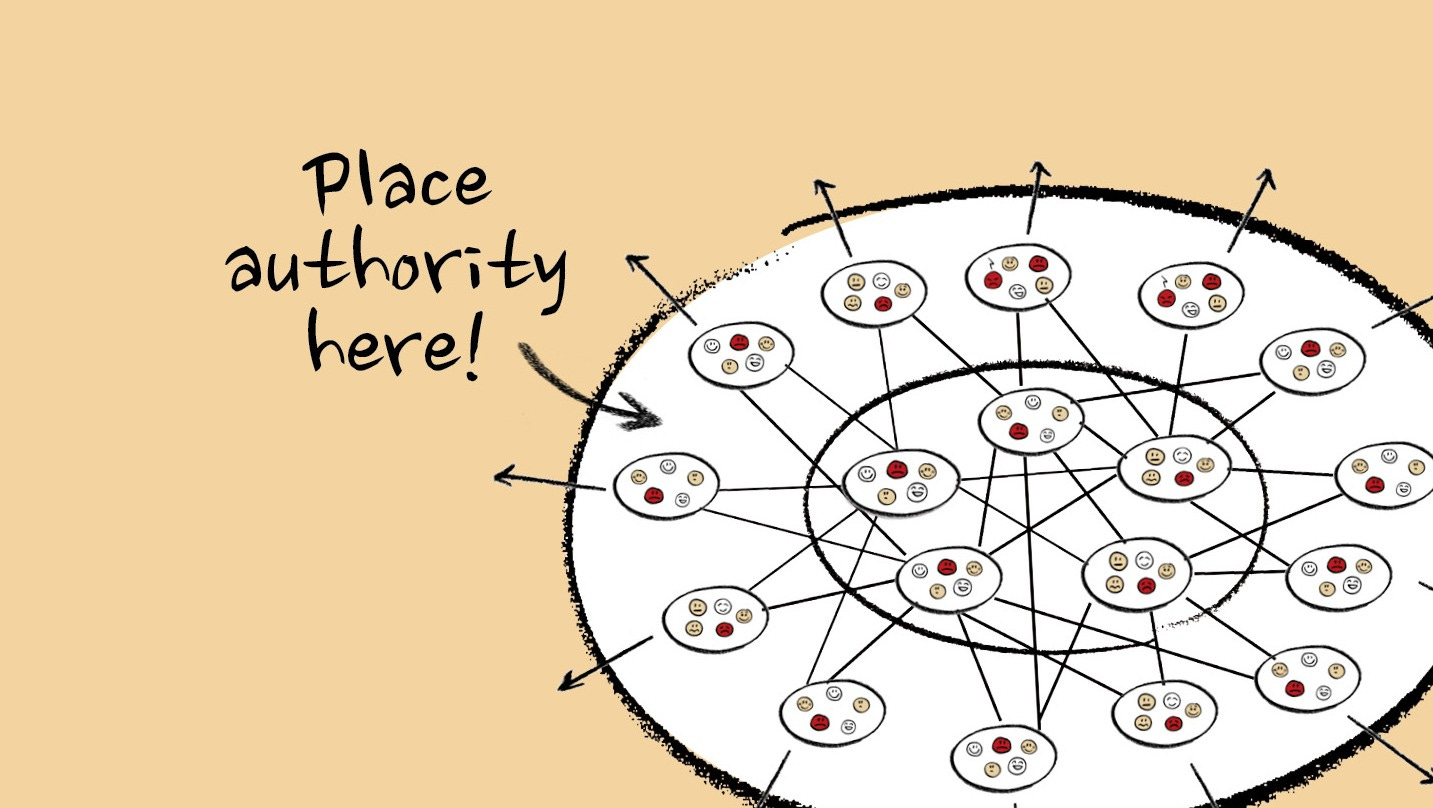
Systems theorists like Gregory Bateson and Niklas Luhmann advocated that definitions are a bore, but that distinctions can be fun and worthwhile, as long as they describe differences that make a difference. In this article, I make the case that empowerment and delegation are identical, in practice, but that it’s smart and useful to distinguish the two from decentralization. Put differently: Decentralization is the real deal – forget the rest!
Empowerment and delegation: They both refer to the transfer of authority from managers or leaders to their individual employees or underlings. What’s important in these concepts is that empowerment and delegation leave the authority of managers and top-down hierarchy in place: The authorization that’s bestowed upon employees can always be taken back. Consequently, empowerment and delegation are matters of managers’ personal style. They are thus fickle and potentially unreliable, as they leave managers and their command-and-control powers in charge. Someone can be authorized today and deauthorized tomorrow – depending on her or his bosses mood.
Decentralization, on the other hand, is a characteristic of a system. It goes beyond an individual manager’s decisions or inclinations. In decentralization, authority shifts towards the periphery, as power is devolved to teams (not individuals) that serve external clients. One might say that in decentralization, team empowerment is wired into an organization’s structure. Here, managers transfer authority and responsibility to teams, instead of just optimizing their personal workloads.
One might say that in decentralization,
team empowerment is built into an organization’s structure.
The reason this matters is that for an organization to become consistently self-organized, or responsive and adaptive, it is not sufficient to empower individual employees. If you want to achieve a more agile organization, then teams, not individuals need to be given authority, in a principled, consistent fashion that goes beyond managerial approval. This is an important distinction, because empowering individuals, or delegating tasks and responsibilities to them usually does not lead to more, or better collaboration. Decentralization does: when teams are empowered, or when decentralization of decisions to the periphery is systematically (not sporadically) achieved, will social density and team autonomy consistently emerge within an organization.
Empowerment and delegation, by contrast, perpetuate the mess of individual isolation and centralized steering by managers and specialists.
Decentralization is the only way to align authority and responsibility
In empowerment and delegation, as in all command-and-control organizing, authority and responsibility remain misaligned. In decentralization, by contrast, authority and responsibility match, as they are integrated into teams or cells.
The alignment of authority and responsibility makes all the difference, and for two reasons: Without it, systematic self-organization cannot be accomplished, and claiming to aim at self-organization will always remain manipulative. It is also key to true collaboration without steering by managers and specialist staff. Collaboration may have become a rather clichéd word, but it is the reason why organizations exist: No single employee in an organization can truly achieve anything significant on her or his own. In organizations, we can only achieve value-creation together, in relationships with-each-other-for-each-other, or within value-creating constellations. Think hospitals, schools, “sales”, production or software development: You always need constellations of people. Organizations are better off when everybody is aware at all times that value is created in the space between people. Not by people, but through people and among people. In actual team interactions.
But such interactions can only happen in flow and free of managerial interference, meddling, and constant steering through coordination or centralized scheduling, if authority and responsibility are aligned. On the team (or cell) level at least. Which is why decentralization is the key to flow and de-bureaucratization, and also to create effective Time-Oriented Work Systems.
If you want to organize misery, play delegation poker
Someone at a conference once told me that she heard of a card deck or tool called Delegation Poker. That card deck, she said, suggested seven different options, or levels of delegation. I laughed at her: “You must be joking,” I said, “surely nobody in her or his right mind would use such a thing! Contemplating seven types of delegation, and nothing else, would be like opting to restrict oneself to 7 shades of misery!” Such a game would propose only terrible options to pick from: All ways of delegating will lead to half-baked authorization. Who would want to use a tool that suggests a variety of ways to remain stuck in hierarchical dependence, if it is autonomy we humans truly yearn for?
Empowerment and delegation have nothing to do with team autonomy.
They are attempts to optimize existing power structures, not attempts to overcome them.
A renaissance in corporate management requires team autonomy. Neither delegation, as propagated in the 1970s and 1980s, nor empowerment as advocated in the 1990s will ever get us to team autonomy worth the name. Because neither delegating, nor empowering individual employees does, in principle, lead to greater self-organization or autonomy. In addition, some people believe that being empowered means doing anything they want – and they do. But no matter how well you delegate or how well you empower people – it won’t make a difference, in the end. There is no right way to do those things, as they all amount to the same thing: Dabbling with centralized control. I believe this is the reason why the empowerment movement of the 1990s ultimately failed and petered out.
Which leads us to the question what becomes of leadership, leaders and leading, in a decentralized and consistently self-organized company.
Personal leadership, employee leadership and leading: They are overrated
The idea of employee leadership – or leadership as managers leading their people – is an artifact of the industrial age. There are historical reasons why this idea is so popular today. In tayloristic management, in command-and-control or Alpha, as we call it, the control, steering and supervision of individual employees by their superiors are incredibly important. The assumption that such “leading” (which is managing, in fact) is natural and inevitable still carries a lot of weight today.
“Employee leadership is highly overrated.”
A more sophisticated conception of leadership, on the other hand, – understood as a social phenomenon between actors, within teams and between teams – attaches very little importance to employee management by superiors. In self-organization, leadership must be perceived a dynamic that takes place in the space between team members and teams. This notion of leadership deliberately dispenses with control that’s embedded outside of teams or cells. This conscious renunciation of external, hierarchical control is clearly evident in the 12 principles of the BetaCodex. Under these conditions, discipline in collaboration becomes possible. Social density can unfold.
The path to happiness at work and high performance is paved with decentralization
If one assumes that people are intrinsically motivated, this means that people want to take on responsibility. They want to explore their potential at work, acquire mastery and contribute to something larger than themselves. And they will do so if the conditions are right: There is no need to promote motivation.
Assume motivation in others. It’s a safe bet.
All that’s needed is to create suitable conditions so that the intrinsic motivation of working people can take hold in the organization, consistently. How can a company achieve high employee satisfaction and high motivation? I think it’s by letting people work in peace. Decentralization is the way.
For more on the topic of decentralization, we recommend reading the Organize for Complexity book, and learning about the Cell Structure Design approach to decentralized organizing. This text was written without the use of A.I., except for translation and research purposes.
I hear a BetaCodex LIVE topic calling…