


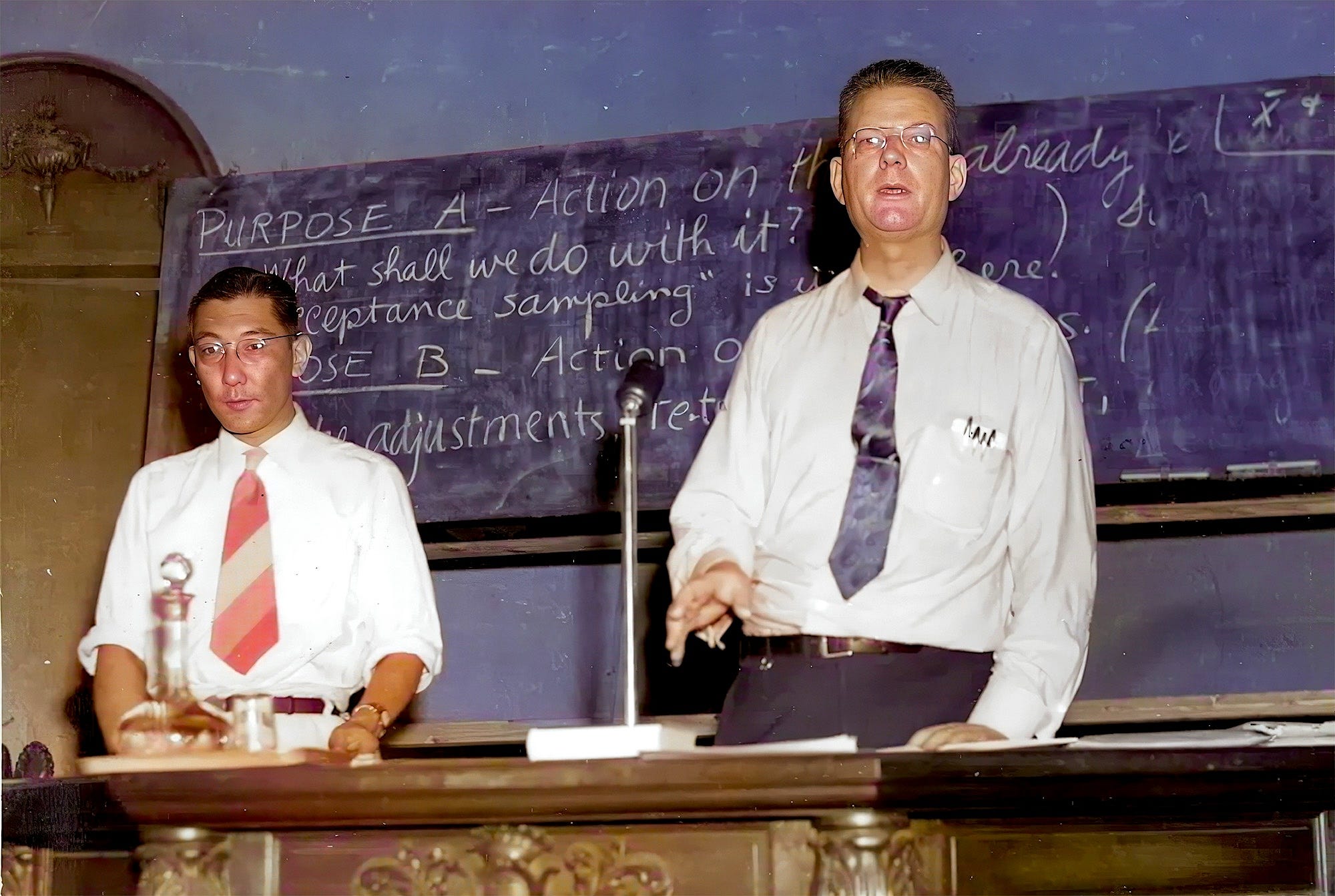
Today, W. Edwards Deming (1900-1993) is probably best known as a business theorist, industrial engineer, management consultant, statistician, and writer. But Deming was also a teacher and professor. For a whopping 47 years, he taught statistics at New York University, NYU (1946-1993) and in his last four years, starting in 1988, he also taught at the business school at Columbia University. While his most famous writings discussed industrial production, business and economics, he applied the same ideas around systems of profound knowledge to teaching in higher education. It is this topic that my very favorite text by Mr. Deming is about.
My choice of “Deming’s best text” is a highly subjective one, of course. I should disclose right away that the topic of statistics, for example, about which Mr Deming published intensely, is not very close to my heart. Publications around statistics are actually the core of his output: least squares and the theory of errors, sampling theory, survey design, non-sampling errors, census methods, sampling in auditing and law, freight-cost analysis, and papers on professional statistical practice and ethics. Most of the roughly 170 articles Mr. Deming published fall into the field of statistics, probably over 80% of the total. Among his works used for teaching was Some Theory of Sampling from 1950 (depicted below), his best-known technical book. The Journal of the American Statistical Association once called it “The ‘bible’ of sampling statisticians.” It was used in graduate survey-sampling courses and by government statisticians. I also own a copy of that book, even though I do not cherish the contents.

As a mathematical physicist, Mr. Deming also published about physics (from the 1920s to early 1940s). The best known of these works is the 1940 Brunauer–Deming–Deming–Teller paper on adsorption isotherms. His publications on the topics of quality and management date mainly from the 1950s to 1990s. These include his Japanese lectures, the famous 14 points, and his most famous books Out of the Crisis and The New Economics. Mr. Deming himself treated many of these publications as “applied statistics”, built on Shewhart’s statistical control and the distinction between enumerative and analytic studies.
Cecilia Kilian, Deming’s assistant for several decades, mentions that, in his teaching, Deming “tells those participants that they are there for education: to learn theory”. It is also in Cecilia Kilian’s remarkable book The World of W. Edwards Deming that I first found the text Memorandum on Teaching, which I consider his best and most powerful piece of writing. You will find the full text below. It’s surprisingly short, just under two print pages long, in Ms. Kilian’s book.
Having been a teacher at business schools in Germany, Austria and Switzerland myself, I can say that this little memo on teaching changed my views on higher education, and on teaching in business schools, more specifically. I find this text outstanding, and for several reasons, which I would like to briefly elaborate on, before sharing the original article with you.
Deming’s message in the memo about the teaching and higher education is similar to what he said about workers, or employees: Don’t blame students or teachers if the learning or teaching is done poorly: The system is the problem - not individual people. But there are some additional caveats here. Let’s start with what is potentially the toughest statement in the memo – about the quality of teachers in higher education:
“It seems to me that the prime requirement for a teacher
is to possess some knowledge to teach. He who does no research possesses not knowledge and has nothing to teach. […] The best insurance that a student can take out [ for his career] is to make sure that his professors do research.”
If you are knowledgeable about Mr. Deming, or if you have read my book What would Deming do?, you might be aware that he had a particular understanding of knowledge, or worthwhile knowledge, which he defined as theory. Sadly, this framing of relevant knowledge has somewhat run out of fashion, lately, both in teaching, and perhaps in the court of public opinion. Deming ponders that students cannot know what “important” content is, and that the best knowledge is knowledge of theory. The following quote from Memorandum on Teaching is about the “right content” to teach:
“Not even the teacher has dependable knowledge about what ought to be taught.
Learning today is preparation for 5, 10, 20 years in the future.”
Which is another argument, in my mind, for the previous point made that teachers in higher education must be doing research themselves. They must be apt at producing knowledge (theory). It is of no use if they just rehash knowledge created by others. Deming then discusses who is fit to judge teachers and their teaching:
“The only suitable judge of a teacher’s knowledge are his peers.
The only objective criterion of knowledge is research worthy of publication.
Publication should of course be measured on some scale of contribution to knowledge, not by numbers of papers.”
This statement has been foundational to the reboot of the BetaCodex Network, which we undertook in late 2022, in order to make the network research-oriented. The logic was (and is) the following: If we as a movement want to “teach” people contemporary organizing, then we cannot do so without producing relevant Beta theory, without publishing proper research and without creating quality knowledge ourselves. We must do research, or we will be irrelevant. Ridiculous even. Like so many teachers in higher education – at least according to the great Mr. Deming.
But, in the end, who am I to make choices and grand comments with regards to this extremely short and utterly brilliant text by the great W. Edwards Deming? Read it for yourself. And read it repeatedly – as I have over the course of the last 15 years.
Memorandum On Teaching,
by W. Edwards Deming
Published in: The American Statistician, Vol. 26, No. 1, Feb. 1972,
as part of the section “A Letter to the Editor”
Dear Sir:
There is much discussion today about student participation in affairs of the university, even in respect to evaluation of teachers and content of courses. Here are some of my thoughts on the matter.
It seems to me that the prime requirement for a teacher is to possess some knowledge to teach. He who does no research possesses not knowledge and has nothing to teach. Of course some people that do good research are also good teachers. This is a fine combination, and one to be thankful for, but not to expect.
No lustre of personality can atone for teaching error instead of truth. One of the finest teachers that I ever knew could hold 300 students spell-bound, teaching what is wrong. The two poorest teachers that I ever had (though a third one ran neck and neck) were Professor Ernest Brown in mathematics at Yale and Sir Ronald Fisher at University College in London. Sir Ernest will be known for centuries for his work in lunar theory, and Sir Ronald for revolutionizing man’s methods of inference. People came from all over the world to listen to their impossible teaching, and to learn from them, and learn they did. I would not trade my good luck to have had these men as teachers for hundreds of lectures by lesser men but “good teachers.”
It is too late when the student finds out that the foundation that he built in college is shaky. He may fill in gaps by self study, but the place to lay the sure foundation is in school. The best insurance that a student can take out is to make sure that his professors do research.
The student is at a disadvantage when asked to evaluate a teacher. On what basis? Lustre of personality? Knowledge of the subject? Content of course? The teacher’s interest in making sure that he is communicating to the students whatever it is that he is trying to say? A student can possibly judge the teacher’s knowledge of the subject, but he can hardly be a judge of the content of the course. Not even the teacher has dependable knowledge about what ought to be taught. Learning today is preparation for 5, 10, 20 years in the future. A student naturally likes what he calls a good teacher, for whatever reasons. What use, then, could be made of student’s evaluation of a teacher?
The problem of identifying a good teacher is not one in consumer research, though every statistician knows well the importance of consumer research. A university should be now, as in days gone by, a place where one may listen and learn from great men.
The only suitable judge of a teacher’s knowledge are his peers. The only objective criterion of knowledge is research worthy of publication. Publication should of course be measured on some scale of contribution to knowledge, not by numbers of papers.
Suggestions from students concerning the content of a course or the competence of a teacher are accordingly, in my judgment, a reckless idea. I would counsel myself and my colleagues to take no notice of evaluation by students. For my own part, I could not teach under a system of evaluation by students.
W. Edwards Deming, Professor of Statistics
Graduate School of Business Administration, New York University
Visit the worthwhile website by The Deming Institute, which also holds most of Deming’s articles and published papers
Check out Cecilia Kilian’s book The World of W. Edwards Deming, which contains the text above
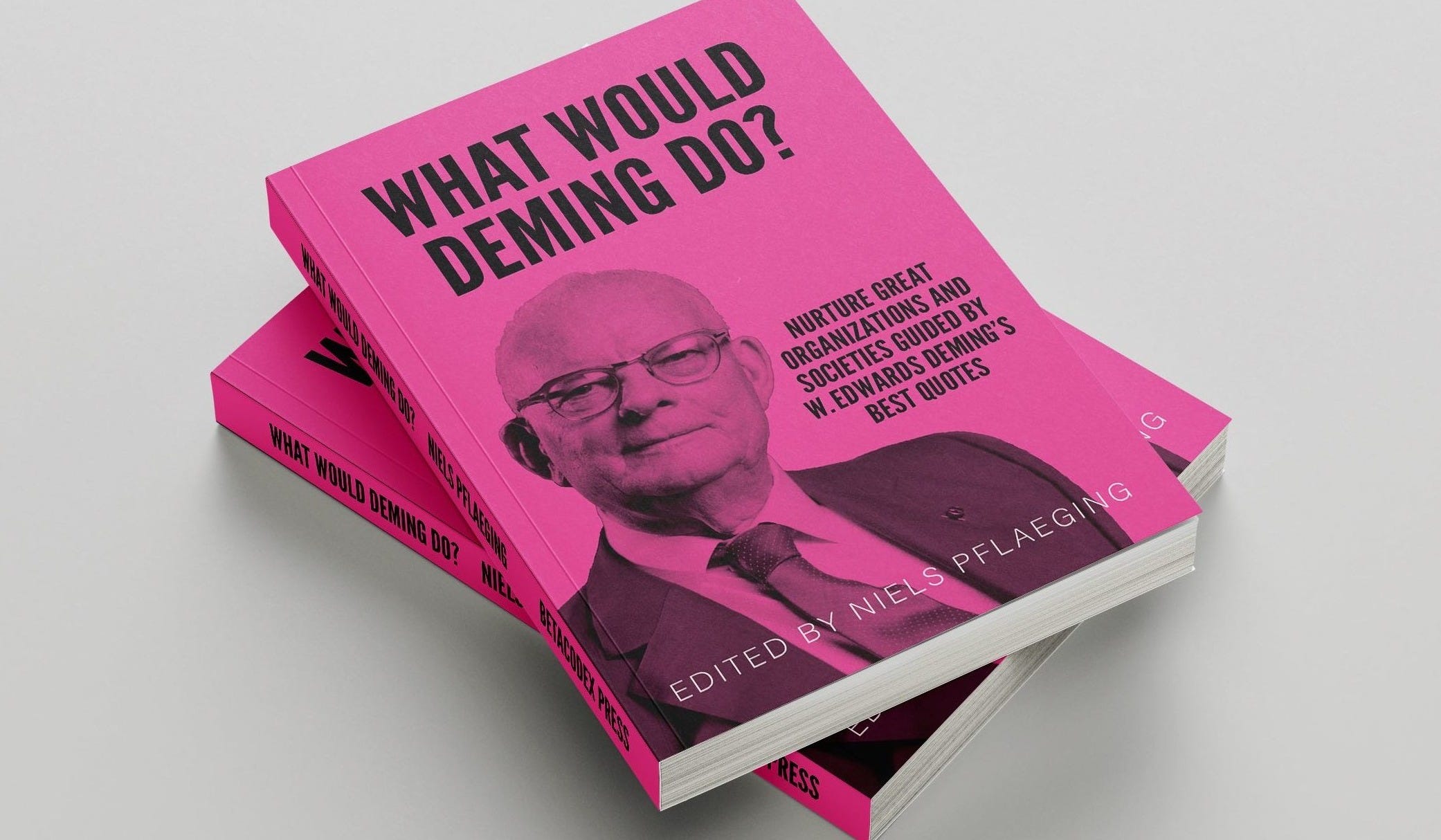
Get your copy of What would Deming do? - a collection of 160+ remarkable quotes by W. Edwards Deming, published by BetaCodex Press
Thank you for this post. It is very well written.